AI Engineer · Technical Founder
Ziad Sakr
AI Engineer. Technical Founder.
Former world-level squash player.
I'm an AI engineer and technical founder building intelligent systems across healthcare and sports. My work spans applied machine learning, AI agents, computer vision, healthcare intelligence, and sports performance technology.
Introduction
I grew up in Egypt's squash system and spent my teenage years trying to read matches faster than my opponents could play them — reaching the top 9 in the world junior rankings, and winning the World Junior Team Championships with Egypt along the way.
I now build systems that read information no person has time to read. At InpharmD that means clinical and pharmaceutical evidence, where an answer that sounds right and is wrong is a real problem. At Core Sports AI, the company I co-founded and lead the technology of, it means match footage — turning video into the kind of read a good coach gives you.
The through-line is the same in both: high-stakes information, systems that have to hold up under scrutiny, and a preference for measuring whether something works over assuming it does.
Current work
Two companies, one problem shape
Both are the same engineering problem wearing different clothes: take a domain where the information is dense, fragmented and consequential — and build systems that read it reliably enough to be trusted.
InpharmD
Founding AI Engineer
Y Combinator-backed healthcare technology company
I build production AI systems for healthcare and pharmacy intelligence — systems that have to hold up against dense clinical literature, drug data, and guidelines where being approximately right is not good enough.
- AI-assisted drug information
- Clinical & pharmaceutical intelligence
- AI agents
- Retrieval & evidence systems
- Therapeutic interchange intelligence
- Formulary & drug-class analysis
Core Sports AI
Co-Founder & CEO
An AI performance intelligence platform for squash.
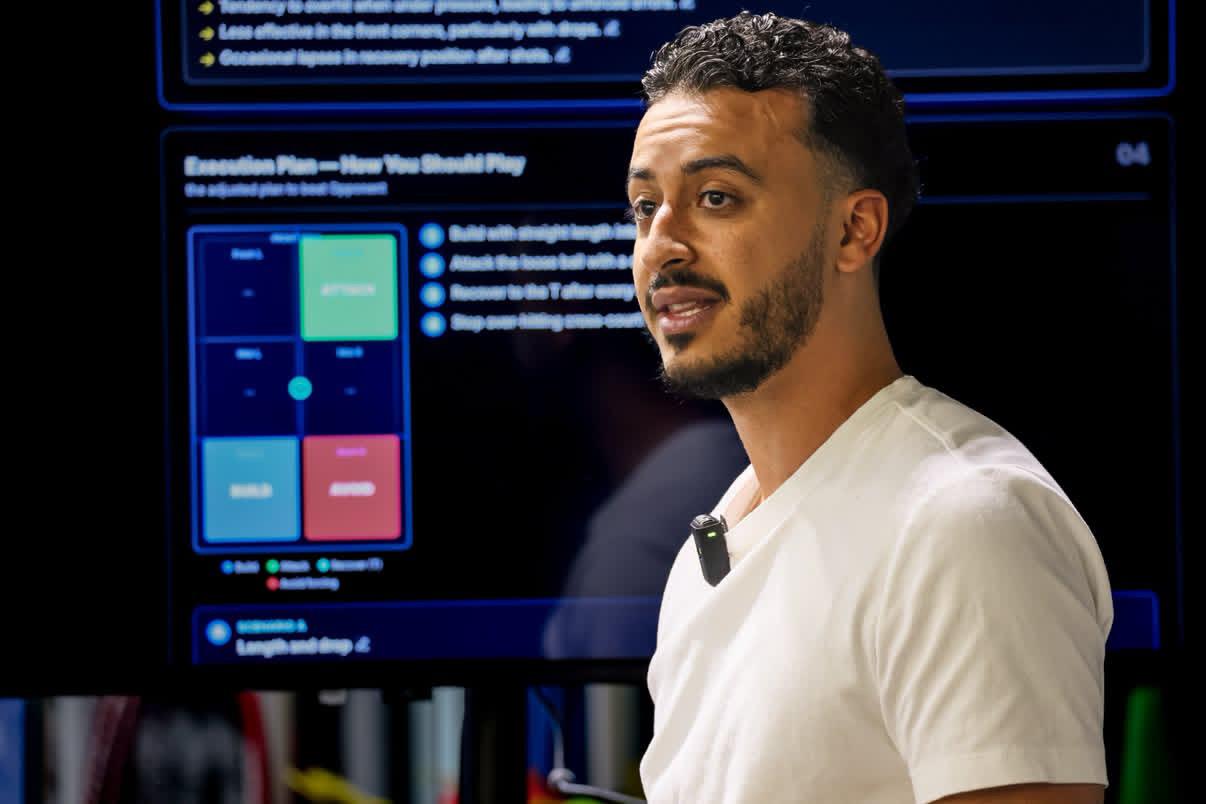
Core Sports AI turns match footage into performance intelligence. Computer vision reads the match — players, ball, shots, positions — and the analytics layer turns that into the kind of read a good coach gives you, at a scale no one can watch by hand.
- Computer vision
- Player & ball tracking
- Tactical analysis
- Digital twins
- Opponent scouting
- AI game plans
Squash → AI
From reading matches to teaching machines to read them
Competitive squash taught me to analyse a match in a way a scoreboard cannot. The score tells you who is winning. It tells you nothing about why. The useful information is in the patterns underneath it.
- Where does a player recover to, and how fast?
- What happens to their shot selection under pressure?
- Which positions on court create attacking opportunities?
- What patterns repeatedly lead to errors?
- How does shot choice change with court position?
- What does an opponent do at 9–9?
As a player, I answered those questions by watching — my own matches, my opponents', the same rally a dozen times looking for the tell. It was slow, subjective, and limited to the footage I had the patience to sit through.
Years later I recognised the same questions in a different form. Where does a player recover to is a tracking problem. What happens under pressure is a temporal pattern problem. What leads to errors is a sequence-modelling problem. Every question a coach asks about a match turns out to be a computer vision, machine learning or data problem underneath.
Core Sports AI came out of that observation. Not that AI should replace the intelligence coaches and elite athletes build over years — it can't — but that a system able to watch thousands of movements, shots, positions and rallies could surface the patterns that a person would need a season of tape study to notice.
Technical work
Engineering intelligent systems
Four areas that keep overlapping in practice — an agent needs retrieval, retrieval needs evaluation, evaluation needs infrastructure, and none of it matters until it survives production.
Applied AI
Systems built on language models that have to be right, and have to keep being right after they ship.
- Large language models
- AI agents
- RAG and retrieval systems
- Evaluation systems
- AI orchestration
- Structured extraction
- Reasoning pipelines
- Production AI systems
Machine Learning
The modelling work underneath the product — and the measurement that keeps it honest.
- Model development
- Data pipelines
- Prediction systems
- Ranking systems
- Evaluation
- ML experimentation
Computer Vision
Reading sport from video: who, where, what happened, and in what order.
- Object detection
- Player tracking
- Ball tracking
- Sports video analysis
- Movement analysis
- Temporal video understanding
Software & Infrastructure
The unglamorous half that decides whether any of the above survives contact with users.
- Backend systems
- APIs
- Cloud infrastructure
- Production deployment
- Data systems
- Scalable AI architecture
Core Sports AI
Match footage in. Performance intelligence out.
Computer vision recovers the structure of a match — players, ball, court, shots — and the analytics layer turns that structure into the read a coach would give you.
Vision
- Automated match analysis
- Computer vision
- Player tracking
- Ball tracking
- Shot recognition
Analysis
- Tactical pattern analysis
- Court positioning
- Performance metrics
- AI-generated match insights
Preparation
- Opponent scouting
- AI game plans
- Match simulations
Development
- Digital player twins
- Player development tracking
- Shareable performance profiles
The Digital Twin
A model of a player that keeps learning them
An evolving representation of an athlete, built from their match history rather than a questionnaire — tendencies, positioning, shot selection and how all of it changes under pressure. It makes two things possible: analysis of what keeps happening across your matches, and scouting an opponent you have never played.
Research & education
Where the engineering was formalised
Boston University
Master's degree
Graduate study, and the point where the machine learning work stopped being self-taught and became method.
Massachusetts Institute of Technology
Research experience
Research conducted at MIT: technical research and experimentation, and the discipline of holding a result to a standard before believing it.
Research experience at MIT — not an MIT degree program.
Trinity College
2017 — 2021
Bachelor's degree, Computer Science · Varsity men's squash
Studied Computer Science while competing for Trinity College, one of the most successful programmes in collegiate squash.
Selected
Milestones
- World Junior Top 9 — Squash
- World Junior Team Champion — Egypt
- British Junior Open U13 Champion
- Three-Time Egyptian Junior National Champion
- CSA All-American — Trinity College2018
- Computer Science — Trinity College2017 — 2021
- Graduate Education — Boston University
- Research Experience — MIT
- Co-Founder — SOLS
- Founding AI Engineer — InpharmD2026
- Co-Founder & CEO — Core Sports AI2024
Writing
Notes on building AI systems
Essays on AI engineering, computer vision, sports intelligence and what elite sport teaches you about building software.
AI Opponent Scouting in Sports
Scouting used to mean a coach with a notebook and whatever footage they could get hold of. AI changes the economics of it — and changes what a scouting report can honestly claim.
Sports AnalyticsArtificial IntelligenceSports Technology4 min readPlayer Tracking vs Ball Tracking in Sports Computer Vision
They sound like the same problem and they are not. One is an identity problem, the other is a signal problem — and treating them alike is the most common mistake in sports vision.
Computer VisionSports TechnologyAI Engineering5 min readWhat Is a Digital Twin for an Athlete?
A Digital Twin is not a 3D model of a player. It is an evolving representation of how someone actually competes, built from their match history — and it is useful precisely because it keeps changing.
Digital TwinsSports AnalyticsArtificial Intelligence5 min read
Contact
Building something at the intersection of AI and the real world?
I'm glad to hear from engineers, founders, researchers, coaches and athletes — and from anyone working on AI systems that have to be right rather than merely impressive.